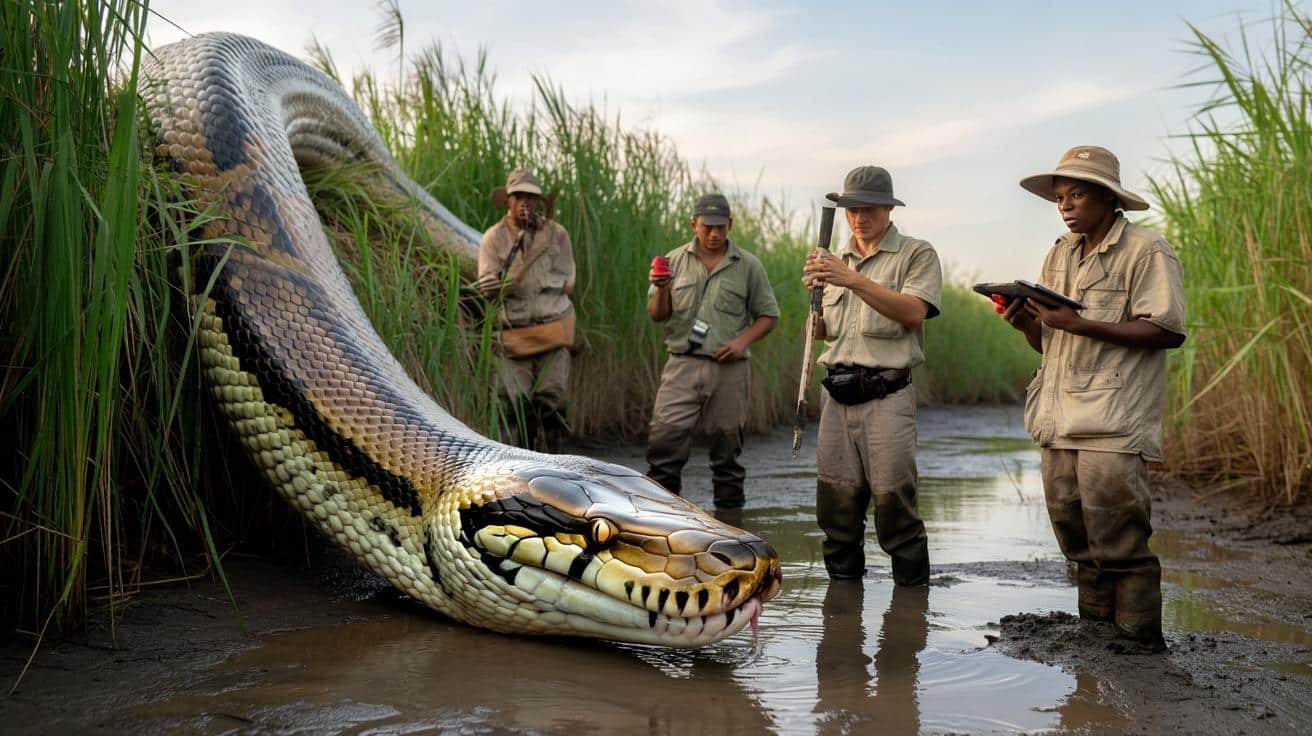

Seen up close, the python didn’t look like the sleek, muscular predators of wildlife documentaries. It looked heavier, older, like a living tree root that had decided to move. The field team, working under a certified biodiversity survey, measured what they could without stressing the animal: several meters of body visible above the reeds, the girth of a truck tire, a head that could easily swallow a duck whole.
Later, back at camp, the tape measure and laser rangefinder came out. Combining visual estimates, overlapping photographs, and reference markers in the vegetation, the team agreed on a conservative length: over 6 meters, with a likely weight surpassing 100 kilograms. That puts it firmly at the extreme upper end of what African rock pythons are known to reach.
For comparison, most African pythons seen near villages or along roads are under 3 meters. Big enough to scare people, yes, but a different league from this. This one was the kind of snake that shapes local legends for decades.
Promoted Content
The moment made its way into field reports, then into a certified expedition log, and finally into excited emails between herpetologists across continents.
The confirmation that such a large individual exists, and was documented under strict scientific protocol, matters far beyond the “wow” factor. Wild animal size records are often surrounded by blurry photos, bar stories, or exaggerations. Having a vetted team, GPS coordinates, standardized measuring methods and multiple witnesses helps cut through the noise.
It also hints at something quietly encouraging: that there are still corners of Africa wild enough to let a predator grow old and enormous. No constant persecution, no relentless habitat loss, no daily conflict with humans.
*In a way, this one snake stands as proof that some ecosystems are still working as they should.*
How herpetologists actually confirm a giant, without turning it into a circus
The team’s first rule was simple: do not grab the snake just to chase a record. Large constrictors stress easily, and a panicked python of that size is dangerous to both itself and humans. So the herpetologists worked like patient detectives.
They took overlapping photos along the body, using a known‑length measuring pole as a scale. They noted exactly where the tail disappeared into the murk. They filmed video while someone walked alongside at a safe distance, counting steps and later translating them into meters with GPS tracks.
This is the quiet side of field science that rarely reaches social media, the part where nobody is shouting, and everyone is just… carefully paying attention.
If you’ve ever been skeptical about “giant snake” headlines, you’re not alone. Lots of supposed monster pythons turn out, on sober review, to be much smaller than first claimed. A coiled snake looks longer. A wide camera angle lies. A fisherman who swears it was “over ten meters” is often telling more of a story than a measurement.
On this expedition, every estimate was checked twice. The longest value was thrown out. The team kept only what they could back up with images, GPS data, and physical reference objects. Let’s be honest: nobody really does this every single day.
That’s why herpetologists get excited when a sighting like this comes stamped with field protocols instead of just bragging rights.
What the team also saw, beyond the tape measure, was the python’s condition. Its body was thick but not bloated, with well‑defined muscle under the patterned scales. No fresh scars from snares or machetes. The behavior was calm, almost bored, as if large prey and deep cover were still abundant in that wetland.
This hints at a functioning food chain: medium and large mammals to hunt, enough undisturbed habitat to hide in, and low pressure from hunters who might kill such a snake out of fear. **A giant predator is always the tip of an invisible pyramid below it.**
Scientists know this intuitively, but standing next to that living evidence hits different than reading a graph in a journal.
What this giant python quietly tells us about people, fear and survival
Herpetologists on that trip followed an unwritten method they’ve learned from years around fearful communities. Whenever they visit villages near known python habitat, they start not with lectures, but with listening. People share stories: goats taken at night, a child frightened near the river, a huge shed skin found near a maize field.
Only then do the scientists explain what they’ve seen on the ground: that very large pythons tend to avoid loud, busy places, that most bites occur when someone tries to kill or capture the snake, and that keeping dogs and goats penned at night can cut conflict.
It’s a slow, human way of working that turns a “monster” into a wild neighbor with predictable habits.
Many of us carry the same deep fear, even if we live thousands of kilometers from any python. We’ve all been there, that moment when a sudden movement in tall grass makes your heart race before your brain catches up. Pop culture doesn’t help, with horror movies and viral clips zooming in on fangs and dramatic coils.
Herpetologists see the harm when fear turns into reflex killing. A farmer spots a big snake, panics, and calls a group of men with sticks. The python dies, but the rats feast on stored grain the next season. No predator, more pests, more poison spread. **The circle rarely looks like “victory” once you zoom out.**
Recognizing that chain of cause and effect is often the first step away from pure fear and toward practical coexistence.
On a radio interview after the expedition, one of the lead researchers put it in simple words:
“People ask if such a big snake is dangerous. I tell them: anything that size deserves respect. But if you don’t grab it, corner it, or try to impress your friends, its main wish is to avoid you.”
From there, the conversation tends to shift toward what communities can actually do. Some of the most repeated, down‑to‑earth ideas from field teams sound like this:
- Use proper, raised pens for goats and chickens at night instead of leaving them tied in open fields.
- Call local wildlife officers or conservation groups when a large snake is seen near homes, rather than handling it alone.
- Teach children to step back and call an adult if they spot a big snake, not to throw stones or sticks at it.
- Maintain some wild buffer areas near wetlands and rivers, instead of clearing every last tree and reed bed.
- Share verified, measured snake stories, not exaggerated ones, so fear doesn’t grow bigger than reality.
These aren’t dramatic fixes, just small, practical gestures that let giant snakes keep doing their quiet ecological work without becoming neighborhood myths that end in panic.
A giant that reminds us how much we still don’t see
The confirmed sighting of this exceptionally large African python landed in scientific inboxes with a mix of joy, disbelief and a hint of nostalgia. For some older herpetologists, it echoed field tales from the 1970s and 80s, when reports of “huge” snakes were more common and wild areas less fragmented. For younger researchers, it felt like a hopeful glitch in the current era of shrinking ranges and vanishing giants.
This one animal won’t solve habitat loss, bushmeat hunting, or climate shifts across the continent. Yet its presence under a certified expedition, logged line by line, shows that the story of big predators in Africa isn’t only about decline. Hidden in swamps, gallery forests and floodplains, some individuals still grow to full, impressive adulthood.
That thought lingers.
Somewhere out there, in another unvisited wetland, another heavy line of moving grass might be tracing out a shape we once thought belonged only to old stories.
| Key point | Detail | Value for the reader |
|---|---|---|
| Certified sighting | Length and size of the python documented under strict field protocols | Helps separate real giants from myths and clickbait |
| Ecological signal | Large predator thriving in intact wetland habitat | Shows that some ecosystems still function and can be protected |
| Human coexistence | Listening to local stories, reducing conflict, practical tips | Offers realistic ways to live alongside feared wildlife |
FAQ:
- Question 1How big can African rock pythons really get?Most adults are between 3 and 4.5 meters, but rare individuals can surpass 6 meters in remote, well‑preserved habitats.
- Question 2Was this giant python captured or relocated?No. The expedition documented the snake using non‑invasive methods and left it in place to avoid stress or injury.
- Question 3Are such large pythons a real threat to people?Serious incidents are extremely rare and usually involve cornered or provoked snakes; they prefer wild prey and to avoid humans.
- Question 4How do scientists measure a snake they can’t fully handle?They combine scaled photos, measuring poles, GPS tracks, and step counts, cross‑checked to get a conservative, reliable estimate.
- Question 5What can local communities do to reduce python conflicts?Pen livestock at night, call trained wildlife teams when a big snake appears, and teach children to keep distance instead of attacking it.