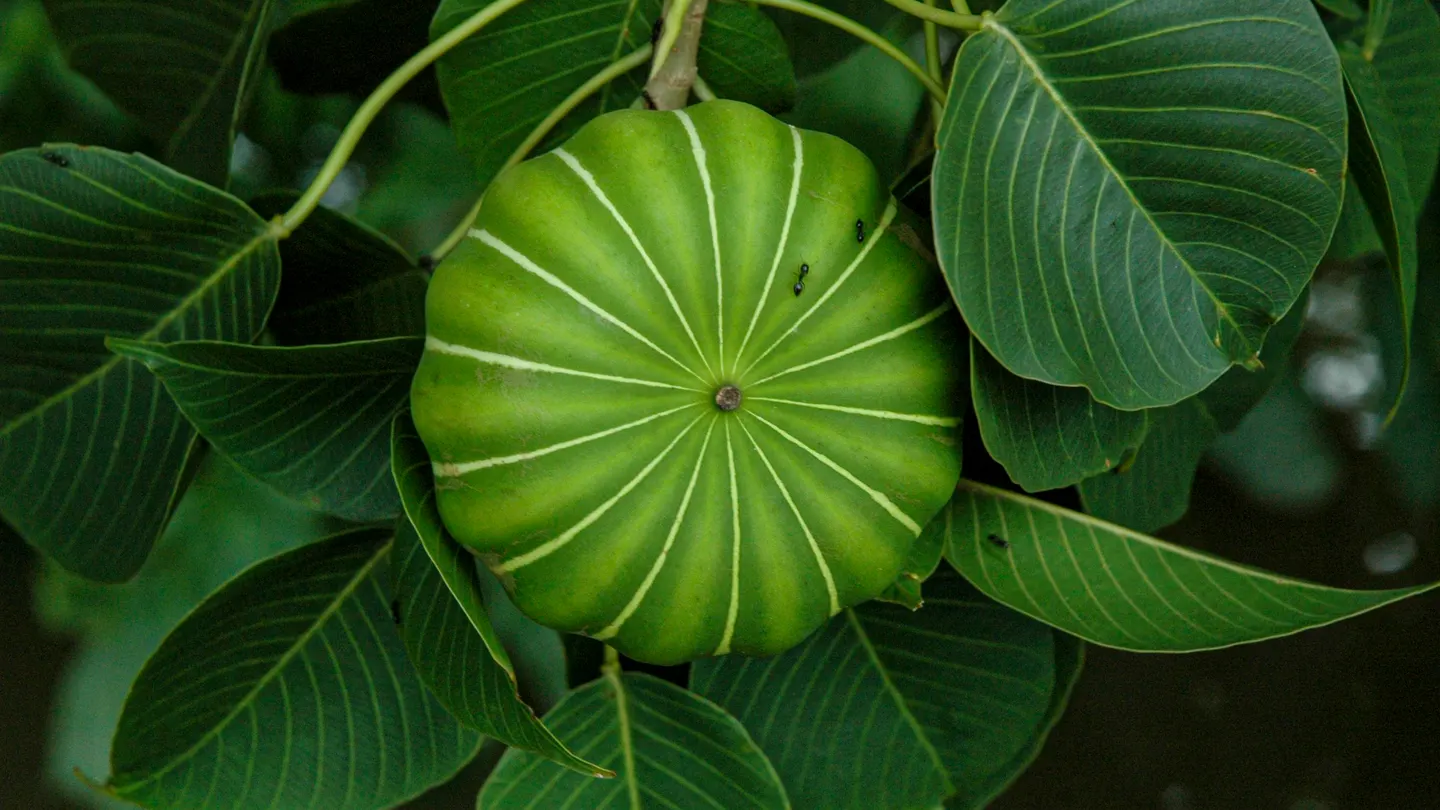

In the rainforests of Central and South America, there stands a tree that, without warning, detonates its fruit with a sharp crack. As a result, seeds are sent flying at speeds that can exceed 150 miles per hour (240 kilometers per hour). The explosion is loud enough to startle animals and force nearby humans to take a step back. Contrary to what some might believe, this isn’t a defensive tactic; it’s simple reproduction.
The sandbox tree (Hura crepitans) belongs to a small but remarkable group of plants that rely on explosive seed dispersal. Here’s how this species — using nothing more than plant tissue, water tension, and mechanical instability — has solved a fundamental evolutionary problem.
The Sandbox Tree’s Evolutionary Problem Of Staying Put
Plants face one major dilemma that the vast majority of animals don’t: once rooted, they’re stuck in that position for good. Their offspring, however, benefit enormously from distance. This means seeds that land too close to the parent will have to compete with them for light, water and nutrients. It also renders them more vulnerable to predators and pathogens that prey on their species.
PROMOTED
For this reason, seed dispersal isn’t optional. It’s one of the strongest selective pressures in plant evolution. Many plants evolve in ways that allow them to outsource the task to animals, by packaging their seeds in sweet fruit or covering them with sticky coatings. Others rely on wind or water.
However, in dense tropical forests, wind is weak and animal dispersers are unreliable. Because of this, some plants needed to find a more direct solution. For the sandbox tree, this meant turning its fruit into a spring-loaded weapon — as classical research published in New Phytologist explains.
MORE FOR YOU
As interesting as this is, the sandbox tree is unique for reasons beyond its explosive reproductive strategy. Its trunk is also covered in thousands of sharp, conical spines, and its sap is highly toxic. Historically, the tree earned its common name because its dried fruit was generally used as a container for ink blotting sand. Unsurprisingly, however, the fruit’s biomechanics are what have drawn the most scientific attention.
The Prompt: Get the week’s biggest AI news on the buzziest companies and boldest breakthroughs, in your inbox.Email AddressSign Up
By signing up, you agree to receive this newsletter, other updates about Forbes and its affiliates’ offerings, our Terms of Service (including resolving disputes on an individual basis via arbitration), and you acknowledge our Privacy Statement. Forbes is protected by reCAPTCHA, and the Google Privacy Policy and Terms of Service apply.
The sandbox tree produces large capsules shaped similarly to a pumpkin, which are divided into wedge-like segments. As the fruit matures and dries, internal stresses build within the walls of the capsule. When those stresses eventually exceed the strength of the tissue holding the segments together, the fruit shatters violently.
As the above study notes, the seeds are launched radially at an astonishing mean speed of 43 meters per second (96 miles per hour) — and sometimes as fast as 70 meters per second (156 miles per hour) — often traveling tens of meters from the parent tree. For context, that’s faster than a major league fastball; it’s even comparable to the muzzle velocity of some air rifles.
Why This Tree’s Explosive Dispersal Works
Unlike animals, plants cannot actively make sudden movements with muscles. Instead, they can only rely on slow energy storage, followed by rapid release. In the sandbox tree, this energy comes from differential drying.
In simpler terms, the fruit’s various layers of tissue lose water as it matures, each often at different rates. But because the plant cell walls are rigid and non-uniform, this uneven shrinkage creates internal tension. As a result, the fruit essentially becomes a biological pressure vessel.
A 2012 study published in PNAS on other explosively dehiscent fruits — specifically, the fruit of the Himalayan balsam (Impatiens glandulifera) — shows that the cellulose fibers within these fruits’ walls are oriented in specific directions.
In other words, as the tissues dry up, the fibers resist contraction along certain axes. This, in turn, causes the fruit to warp and store elastic energy. When the seams between the segments eventually fail under the pressure, the stored energy is released in milliseconds. The result is a burst fast enough to rival some engineered mechanical systems.
From a physics standpoint, this is extraordinary. Given that the seeds themselves are relatively small, they undergo extreme acceleration over very short distances. What’s even more impressive is that the plant accomplishes this remarkable feat without the help of nerves, sensors or even any kind of active control over the behavior. The explosion occurs purely due to the intersection of material properties and geometry.
The sandbox tree is an example of a species that perfectly exploits elastic instability: when a system is slowly pushed into a stressed state, which leads it to release its energy catastrophically as soon as a certain threshold is crossed. This kind of explosive seed dispersal is incredibly risky; seeds are flung blindly, and there’s no guarantee that they’ll land in a favorable environment.
But when it works, it works very well. And from an evolutionary perspective, the strategy only needs to succeed occasionally to be favored by natural selection.
When successful, the child sandbox tree will have little to no competition with its siblings, and it also has a lesser chance of density-dependent mortality. Moreover, any predators that specialize in feeding near adult trees are also less likely to encounter the dispersed seeds.
Why This Tree Is So Evolutionarily Impressive
From a biological standpoint, the sandbox tree challenges the intuition that plants are purely passive organisms. They may grow slowly and simply, but this doesn’t mean they aren’t complex organisms. The fruit of Hura crepitans is a composite structure optimized efficiently by evolution, especially in terms of:
- Cell wall thickness
- Fiber orientation
- Moisture sensitivity
- Fruit geometry
Small genetic changes that alter tissue stiffness or drying rate can dramatically affect the seed’s dispersal distance. And over time, evolution fine-tunes these different parameters just as precisely as it does animal anatomy.
The idea that a tree can hurl its seeds faster than a car on the highway feels almost absurd. Yet it’s a real, measurable and repeatable behavior you could observe for yourself. And in a forest that’s filled with countless small adaptations, the sandbox tree is one of nature’s loudest, fastest reminders that plants are anything but inert.
How connected do you feel to the living world around you? Discover your relationship with nature, from forest floor to tree canopy, with this science-backed test: Connectedness to Nature Scale
Tree Knowledge Challenge: The Sandbox tree is just one of nature’s extreme adaptations. How much do you really know about the biology of the forest? Take the Tree IQ Test to assess your understanding of dendrology.