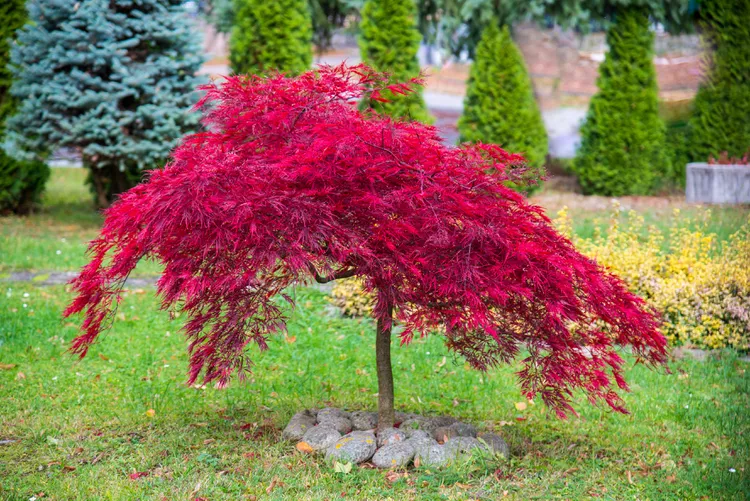

Regardless of whether you grow a Japanese maple (Acer palmatum) with an upright or weeping habit, its colorful fall foliage and delicate form never fail to impress. These trees are relatively easy to care for, but they do need some maintenance to make the most of them.
Learn when, why, and how to prune a Japanese maple to keep your tree healthy and beautiful.
When to Prune Japanese Maple Trees
Do the bulk of Japanese maple pruning in the late winter or early spring months, during the tree’s dormancy period and after the extreme cold has passed.
Pruning at this time reduces the risk of subjecting the tree to stress or disease. Viewing the branches free from foliage also allows you to see the tree’s structure and more easily identify the best places to make cuts.
Avoid major pruning in the late spring and summer during its active growth period. The new growth is more susceptible to extreme weather and pest damage.
Plus, you want the tree to focus on foliage development during this time rather than energy diverting to cut wood wound healing. Fall is the worst time to prune trees as it makes them more vulnerable to frost damage.
However, light trimming for aesthetics and to keep the tree’s layers airy in the late spring or early summer is acceptable. You can also remove dead, diseased, or damaged wood throughout the year.
Want more gardening tips? Sign up for our free gardening newsletter for our best-growing tips, troubleshooting hacks, and more!
How to Prune Japanese Maple Trees
Pruning Japanese maples combines science and artistry to keep your tree strong and with an aesthetically pleasing and suitably-sized structure.
1. Remove Diseased, Dying, or Dead Branches
Inspect the tree for dead, dying, damaged, or diseased branches. When removing any deadwood, cut just above the branch collar. This is the line where the branch joins an old branch or the tree’s main trunk.
Use sterile, sharp tools to make your cuts. Disinfecting the tools before and after use reduces the risk of spreading disease. Hand pruners work for smaller branches, but you’ll need heavier-duty lopping shears for larger, higher, hard-to-reach branches.
2. Shape for Form and Size
Once your Japanese maple is two or three years old and has grown into its natural shape, you can prune during the dormancy period to produce the desired shape, height and width.
The goal is to create overlapping layers of non-touching branches that allow you to see between the leaf layers. Focus on removing crossing, touching, weak, or misshapen branches that grow upwards or downwards into other layers, and remove twiggy, spindly growth down the trunk.
Cut the branches back to a lateral bud or branch rather than in the middle. It’s best to cut overlapping branches at the base nearest the trunk to prevent future crossing.
Work your way up from the bottom of the tree, tackling the inside limbs first. Avoid creating large holes in the canopy or removing more than 30% of the tree, as this can put it under too much stress. Aim for a balanced appearance that thins out crowded canopy areas and allows light to reach the inner branches.
3. Lightly Trim in the Summer
While you should do the bulk of the pruning during your Japanese maple’s dormancy period, a bit more light trimming in the summer—when the canopy has its leaves—can promote the most aesthetically pleasing and neat shape. The key is to keep the trimming light to avoid stressing your tree.
4. Remove Problematic Buds
It’s worth monitoring late spring and summer bud formation. It is easier for you and less stressful for the tree to remove the buds growing in an undesirable location by hand than to remove them once the branch has grown.
6 Reasons Why You Should Prune Japanese Maple Trees
There are several structural and aesthetic benefits to pruning Japanese maple trees. These include:
- Promotes a strong structure. Directing the tree’s growth habit circumvents weakness due to overlapping, overcrowding, or spindly branches.
- Improves air circulation. Pruning encourages healthy growth of inner branches and reduces the risk of disease.
- Encourages vigorous new growth. Removing dying or diseased limbs directs the tree’s energy to new branches.
- Maintains an appropriate size. Trimming to control height and width prevents your Japanese maple from outgrowing the space.
- Tidies your tree. A shapely tree is more aesthetically pleasing than a straggly one.
- Safety. Removing dead or damaged branches prevents them from falling and causing injury or damage to nearby property.
4 Japanese Maple Tree Pruning Tips
Here are some other handy Japanese maple pruning tips to keep in mind when tackling this task.
- Create Y-shaped branches. When limbs have extra branches, removing the ones in the center of the stem to create a “Y” shape promotes a tidier appearance.
- Work with the tree’s natural form. Don’t try to change the natural cascading form of the weeping species, such as the Crimson Queen. Prune to achieve an umbrella-like shape. For upright forms, decide if you want a multi-stemmed tree. You can opt for one, three, or more leaders, but avoid two as this can result in splitting.
- Water well after pruning. This helps the tree heal from the pruning wounds and reduces stress.
- Avoid removing large limbs. It’s best to keep healthy branches that are more than 1/4 of the size of the trunk, as this supports a strong structure.