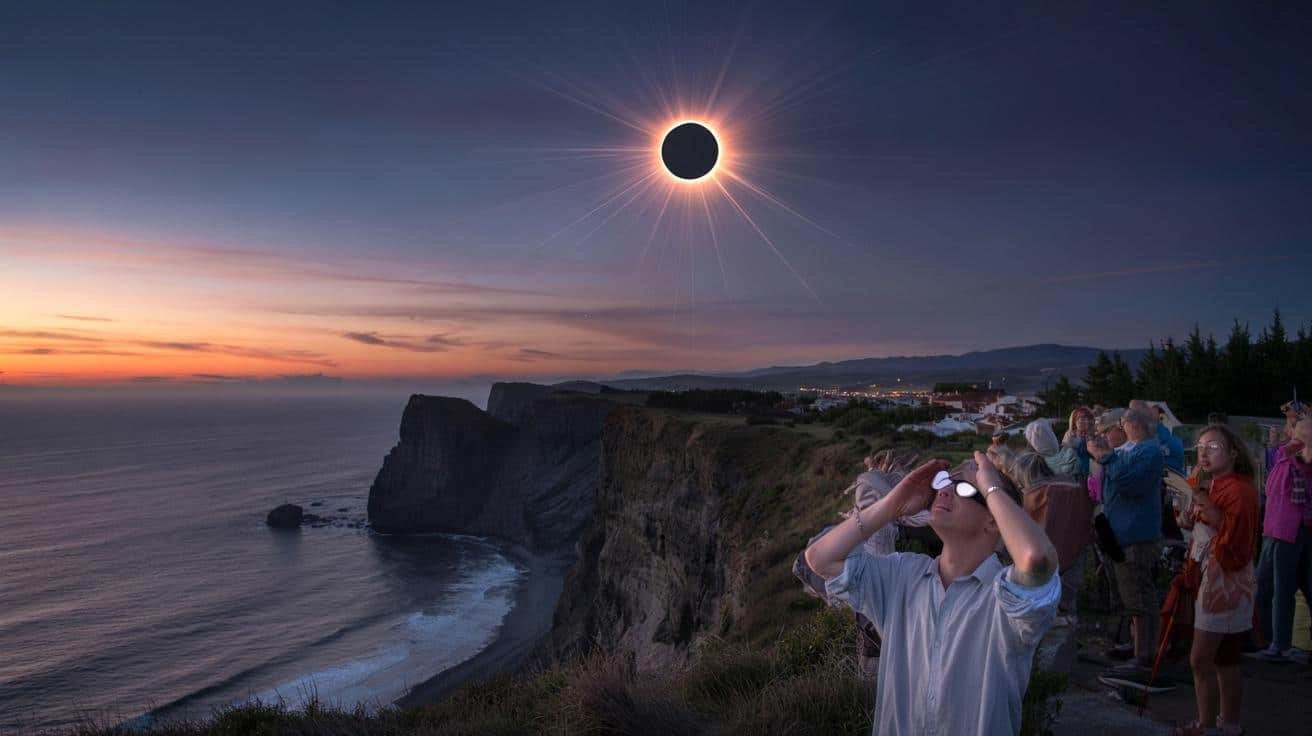

Few natural events inspire awe quite like a total solar eclipse. For a brief moment, day turns into night, temperatures drop, stars appear in the sky, and the Sun’s glowing corona becomes visible to the naked eye. Among these celestial spectacles, one upcoming event has earned a dramatic title: the “eclipse of the century.” Scientists and skywatchers alike are calling it extraordinary—not only because of its timing, but also because it will bring nearly six minutes of total darkness, a duration rarely achieved in modern times.
This once-in-a-lifetime event is expected to draw millions of observers from around the world. From professional astronomers to first-time eclipse chasers, anticipation is building as people prepare to witness one of nature’s most breathtaking displays.
What Makes This Eclipse So Special?
Not all total solar eclipses are created equal. While they occur somewhere on Earth roughly every 18 months, most last only two to three minutes at their maximum. An eclipse approaching six minutes of totality is exceptionally rare.
This “eclipse of the century” stands out for several reasons. The Moon will be positioned at a near-perfect distance from Earth, appearing large enough in the sky to completely cover the Sun. At the same time, Earth will be at a favorable point in its orbit, allowing the Moon’s shadow to move more slowly across the planet’s surface. The combination of these factors creates an unusually long period of total darkness.
For scientists, this extended duration offers valuable research opportunities. For observers, it means more time to absorb the surreal experience without feeling rushed.
The Exact Date of the Eclipse
The eclipse of the century is set to occur on August 2, 2027. On this date, the Moon’s shadow will sweep across parts of Europe, North Africa, and the Middle East before fading away.
While partial phases of the eclipse will be visible from a much wider region, only those within the narrow path of totality will experience the full effect—complete darkness during the daytime.
Astronomers have calculated that the maximum totality will last approximately five minutes and fifty-eight seconds, placing it among the longest total solar eclipses of the 21st century.
Nearly Six Minutes of Total Darkness
During totality, the Sun will be entirely hidden behind the Moon, plunging the landscape into an eerie twilight. Birds may fall silent, temperatures can drop noticeably, and the horizon will glow with a 360-degree sunset effect.
What makes this eclipse particularly remarkable is the length of totality. Nearly six minutes allows observers to notice subtle details that shorter eclipses often conceal. The Sun’s corona—its outer atmosphere—will appear as delicate, shimmering streamers extending into space. Bright planets and stars may become visible, and solar prominences may glow pink along the Moon’s edge.
For many people, even a few seconds of totality can be emotional. Experiencing it for almost six minutes is expected to be unforgettable.
The Path of Totality Explained
The path of totality is the narrow corridor where the Moon completely blocks the Sun. Outside this path, observers will only see a partial eclipse.
For the 2027 eclipse, the path of totality will stretch thousands of kilometers but remain relatively narrow, measuring roughly 250 kilometers wide. It will begin over the Atlantic Ocean, pass through southern Europe, cross North Africa, and continue through parts of the Middle East before ending over the Indian Ocean.
Only locations directly within this path will experience the full duration of total darkness. Even a short distance outside the path can mean missing totality altogether.
Best Places to Witness the Eclipse
Choosing the right location is crucial for experiencing the eclipse at its best. Weather conditions, accessibility, and duration of totality all play a role.
Southern Spain
Parts of southern Spain, particularly along the Mediterranean coast, will lie within the path of totality. These areas are known for clear summer skies, making them excellent viewing spots. Spain also offers strong infrastructure, making travel and accommodations easier for international visitors.
North Africa
Countries such as Morocco, Algeria, Tunisia, Libya, and Egypt will experience some of the longest durations of totality. In parts of Egypt, observers may witness close to the maximum length of darkness. Desert climates in these regions often provide clear skies, increasing the chances of a successful viewing.
The Middle East
Sections of Saudi Arabia and surrounding areas will also fall within the path. While conditions vary, some locations are expected to offer clear skies and dramatic landscapes for eclipse viewing.
Each region has its own advantages, and eclipse chasers are already planning years in advance to secure prime viewing locations.
Preparing for the Eclipse
Witnessing a total solar eclipse requires preparation, especially for an event of this scale.
Eye safety is essential. During the partial phases, viewers must use certified solar viewing glasses to protect their eyes. Only during the brief period of totality is it safe to look directly at the Sun without protection.
Travel planning is equally important. Hotels in prime locations are likely to fill up quickly, and transportation may become crowded as the date approaches. Many experienced eclipse chasers recommend arriving several days early and having backup viewing locations in case of unexpected weather changes.
Photography enthusiasts should also prepare in advance. Capturing an eclipse requires specialized filters and careful planning, particularly for a long totality like this one.
Scientific Importance of the Eclipse
Beyond its visual beauty, the eclipse of the century holds significant scientific value. Extended totality allows researchers to study the Sun’s corona in greater detail, helping to improve understanding of solar winds, magnetic fields, and space weather.
Solar eclipses also provide opportunities to test instruments, observe atmospheric changes on Earth, and refine astronomical models. Even with modern satellites, ground-based observations during eclipses remain invaluable.
Why This Eclipse Truly Deserves the Title
The term “eclipse of the century” is not used lightly. While there will be other eclipses in the future, few will combine such a long duration of totality with accessibility to populated regions.
For millions of people, this may be the only chance in their lifetime to experience nearly six minutes of daytime darkness caused by a total solar eclipse. It is a rare alignment of cosmic timing and geography.
A Once-in-a-Lifetime Experience
As August 2, 2027 approaches, excitement will continue to grow. This eclipse is more than an astronomical event—it is a shared human experience that connects people across cultures and continents under the same darkened sky.
For those lucky enough to stand in the path of totality, the eclipse of the century will be a moment of wonder, humility, and profound beauty. When the Sun re-emerges and daylight returns, it will leave behind memories that last a lifetime—proof that even in our modern world, the universe can still stop us in our tracks.