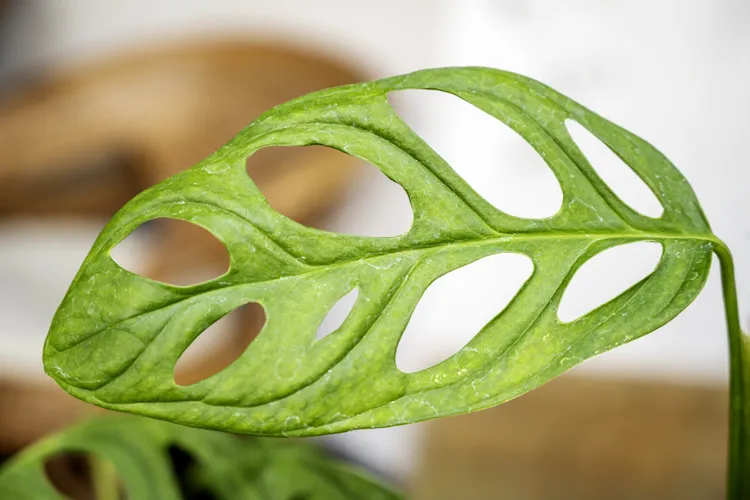

Monstera obliqua is a striking tropical plant known for its distinctive appearance and unique characteristics. This rare variety has large, broad leaves with classic monstera holes, larger than those of other types, giving it a lace-like appearance. The leaves of Monstera obliqua are thinner and more delicate, showcasing fenestrations that can reach up to 90 percent of the leaf’s surface area.
Hailing from Central and South America, Monstera obliqua is a rare evergreen trailing shrub that thrives in high-humidity environments. Due to its unique cultivation requirements, it is considered more challenging to grow, making it a unique addition for dedicated plant collectors.
Since Monstera obliqua is not typically available in regular plant stores, you may need to reach out to a specialty grower to find one. If you’re ready for a challenge, our gardening experts offer valuable tips and strategies to ensure that your Monstera obliqua gets the best care and thrives indoors.
- Zoe Zhang, founder of Plantoem in Honolulu, Hawaii
- Rachael Kemery, founder of Rising Iris Farm
- Amanda Rodrigues, owner of the Plant Stand of Arizona
Care Requirements
While Monstera obliqua isn’t as easygoing as other Monstera varieties, with the right care and dedication, your plant can thrive. Here, Zoe Zhang of Plantoem shares the optimal care conditions that will nurture your rare Monstera as it grows indoors.
Sunlight
Monstera obliqua prefers six to eight hours of daily, bright indirect light, diffused sunlight, or dappled sunlight to maintain optimal growth.
Soil
This tropical plant thrives in a chunky, airy, well-draining aroid soil mix. To create a blend that mimics the tropical environment, Zhang recommends using equal parts coco coir, coco chips, perlite, and horticultural charcoal, with optional additions of pumice and worm castings. You can also combine equal parts potting soil, perlite, and orchid bark.
Temperature
Ideal temperatures for Monstera obliqua range from 65 to 85 degrees Fahrenheit. “Anywhere close to or below 50 degrees Fahrenheit will cause cold damage, and temperatures above 90 degrees Fahrenheit could cause scorching on the leaves,” Zhang says. She notes that at 60 to 80 percent humidity, Monstera obliqua can tolerate slightly cooler temperatures down to 60 degrees Fahrenheit.
Humidity
This plant is native to rainforest environments and thrives in high humidity. To ensure optimal growth, maintain humidity levels at 80 percent or higher. It is best grown in a terrarium or greenhouse cabinet, but there are other ways to increase humidity in your home.
Alternatives include grouping plants together, using a humidifier, placing pebble trays filled with water around the plants, or putting plants in a grow tent. These methods will help create a more favorable microclimate for your Monstera obliqua. Investing in a humidity gauge will allow you to accurately monitor the humidity levels in your environment.
Fertilizer
Monstera obliqua appreciates a well-balanced houseplant fertilizer, such as a 20-20-20 or 10-10-10. Zhang notes that using half-strength liquid fertilizer can significantly enhance the growth of large, healthy leaves with delicate foliage while minimizing the risk of leaf burn from over-fertilization.
Fertilizers should be applied during the active growing seasons of spring and summer. Stop fertilizing in fall and winter when growth slows. In warmer regions, year-round fertilization is important.
Climbing Support
Monstera obliqua requires strong support, as it can grow over 10 feet tall. A moss pole is recommended, as it retains moisture and encourages all the nodes to root into it. Zhang says that providing climbing support helps the plant develop larger leaves and a stronger root system, which is essential for recovering from issues like overwatering.
Types of Monstera Obliqua
Monstera obliqua isn’t just one plant, but a species with several distinct forms. The main types include Monstera obliqua Bolivia, which has smaller holes; Monstera obliqua Amazonas, which features spade-like holes; and Monstera obliqua Surinam, the original and rarest species.
Always wear gloves when pruning, propagating, or repotting Monstera obliqua, as the plant produces a toxic sap containing calcium oxalate crystals that can irritate the skin. Monstera obliqua is toxic to humans, cats, and dogs if ingested.
How to Prune Monstera Obliqua
Pruning Monstera obliqua is relatively simple, says Zhang. This practice helps keep the plant at a manageable height and promotes healthy new leaf growth.
- Remove dead matter: Remove dead, yellowing, or long, lanky stems. This allows the plant to direct its energy toward new healthy growth.
- Locate leaf nodes: Find the leaf node that looks like a small bump or joint on the stem where a leaf or aerial root grows from. This is where you’ll make your cuts.
- Make the cut: Cut the stem at a 45-degree angle, about a quarter to a half-inch above the leaf node, leaving the leaf node intact. This will encourage new growth from that node. Keep pruning until you have reached your desired shape and length.
How to Propagate Monstera Obliqua
Propagating plants is an effective way to expand your collection. “Propagation is easiest when the plant is actively growing,” says Rachael Kemery, founder of Rising Iris Farm. Even indoors, Kemery says late spring through summer is generally best for propagation, as light is steadier, temperatures are more consistent, and plants generally recover more easily from change.
- Select a healthy stem: Select a healthy stem with one leaf and a visible node. “If the plant has an aerial root near the node, keep it intact. It isn’t essential, but it improves the chance of successful rooting,” says Kemery.
- Make a cut: Using clean, sharp scissors or pruning shears, make a cut just below the node. “A clean cut heals faster and reduces the risk of rot,” says Kemery.
- Place the cutting in water: Place the cutting in a glass of water so the node is fully submerged and the leaf stays above the surface. Place it in bright, indirect light and change the water every five to seven days. “Roots usually appear within a few weeks, though Monstera obliqua is rarely in a hurry,” says Kemery.
- Maintain steady temperatures: While the cutting is rooting, aim for a stable indoor temperature between 70 and 80 degrees Fahrenheit. Avoid drafts, cold windowsills, or spots that swing noticeably between warm and cool.
- Look for roots: Once the roots reach about 1 to 2 inches long, the cutting is ready to be planted in soil.
Don’t Miss
How Often to Water Monstera So It Thrives for Decades, According to Houseplant Experts
How to Propagate Monstera for an Endless Supply of Houseplants, According to Horticulturists
How to Pot Monstera Obliqua
With the right-sized container, quality potting soil, and optimal conditions, potting your cutting is straightforward.
- Select a pot: Choose a pot that is slightly wider than the root system—typically a 3- or 4-inch pot for roots that fit comfortably in your hand. Ensure the pot has drainage holes.
- Fill with soil: Fill the container with a fast-draining indoor plant mix for tropical plants.
- Plant the cutting: Place the roots downward in the pot, keeping the node at or just below the soil surface while leaving much of the stem exposed. Gently press the soil and water lightly. Prioritize stability by providing bright, indirect light and avoiding fertilizing for a few weeks to support healthy growth.
How to Repot Monstera Obliqua
If you have already potted a cutting, repotting it will feel familiar. “The difference is that you’re working around an established root system rather than placing new roots,” says Kemery.
Keep in mind Monstera obliqua doesn’t need frequent repotting. “It’s best to do this only when the roots clearly fill the pot or begin growing out of the drainage holes,” she says. Repotting too early often causes more stress than it does benefits. Avoid fertilizing for the first month after repotting to allow the plant to adjust.
- Select a pot and add soil: Select a new pot that is one size larger than the plant’s existing pot. Add fresh soil to the bottom of your pot.
- Position the plant: Gently remove the plant from its current container and place it in the new pot so the base of the stem sits at the same height as before.
- Fill with soil: Fill in around the sides with soil, press lightly, and water thoroughly, allowing excess water to drain away.
- Let the plant adjust: Return the plant to its usual spot and give it time to adjust. “Skip fertilizer for the first few weeks, then resume light feeding every four to six weeks with a diluted, balanced indoor plant fertilizer once new growth appears,” Kemery says.
Common Pests and Diseases
Like many indoor plants with thin leaves, Monstera obliqua can attract spider mites, thrips, and mealybugs, particularly in dry air. “Checking the undersides of leaves during regular watering is often enough to catch problems early, when they’re easier to manage,” says Kemery.
Root rot is a common issue for this plant. Signs of root rot include yellowing leaves, wilting leaves, mushy stems, and dead, dark-colored roots that feel soft to the touch. To prevent root rot, avoid overwatering and ensure the pot has adequate drainage.
Common Problems
When the growing environment lacks essential elements, Monstera obliqua will display signs of distress. Luckily, with a few adjustments, these issues can be mitigated.
Dry Leaves
Dry leaves are a common issue for Monstera obliqua because of insufficient humidity. Purchasing a humidity gauge can help prevent this common problem and boost humidity as soon as possible.
Lack of Fenestration
Young plants or those not receiving enough light may not develop the characteristic leaf holes or splits. To resolve this issue, ensure your plant receives plenty of sunlight.
Frequently Asked Questions
- How big does a Monstera obliqua get?Monstera obliqua can reach 4 to 5 feet tall indoors and 6 to 10 feet tall outside, says Amanda Rodrigues of the Plant Stand of Arizona. This is why it’s crucial to provide climbing support for Monstera plants. “In nature, they grow at the base of large trees and use their aerial roots for stability as they climb the trunk; it is ideal to mimic this concept indoors with a trellis or moss poles for support,” she says.
- Is Monstera obliqua hard to grow?Yes. “While this plant is unique and beautiful, it does require very specific environmental conditions to thrive,” says Rodrigues. If you plan to keep this plant in your home, it will do best in a terrarium or greenhouse cabinet.
- Can Monstera obliqua grow in water?Monstera obliqua can grow in water, but Rodrigues notes that improper care can lead to root problems. “Full water growth is best used for the propagation stage,” she says. If you plan to grow your obliqua in water, Rodrigues notes that it is crucial to provide climbing support with a moss pole or trellis.