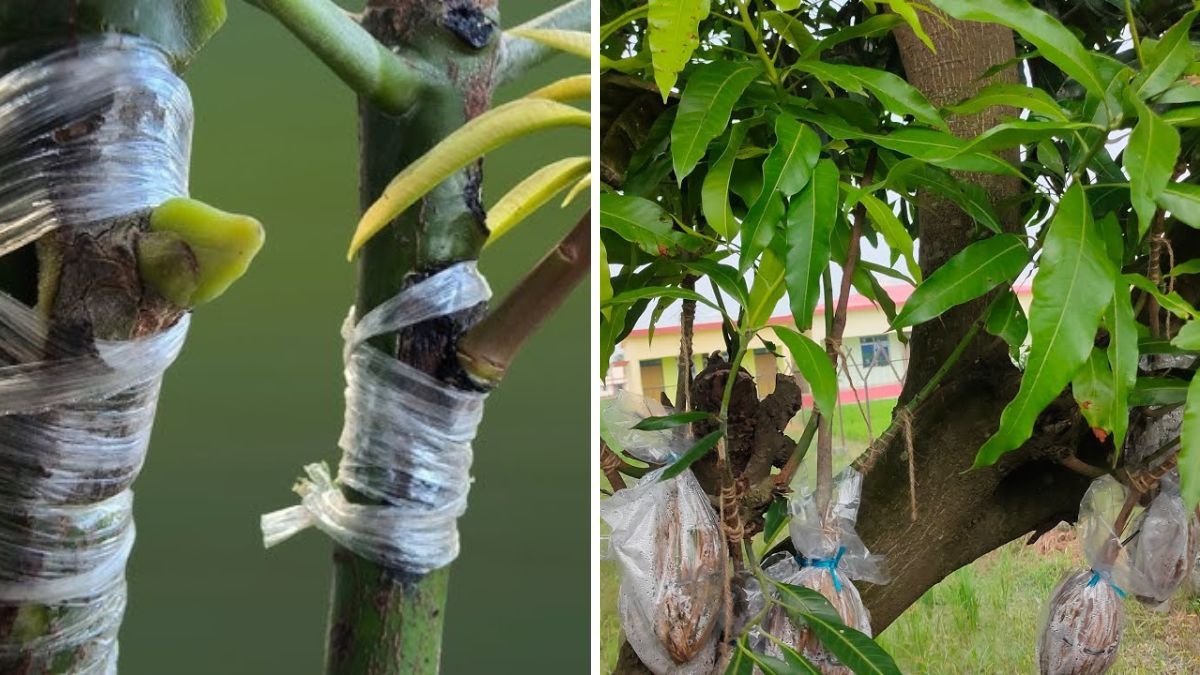

Introduction to Mango V Grafting
Mango V grafting is one of the most reliable and widely used vegetative propagation methods in mango cultivation. This technique is preferred by nurseries and farmers due to its high success rate and uniform plant quality. V grafting helps produce true-to-type mango plants that retain the characteristics of the mother variety. It is especially useful for commercial mango orchards where consistency in fruit quality is essential. The method involves joining a V-shaped scion with a matching cut on the rootstock. When done correctly, healing is fast and strong. Mango V grafting ensures early bearing compared to seed-grown plants. This article explains the entire process in detail.
What Is Mango V Grafting Technique
Mango V grafting is a type of softwood grafting where the scion is cut into a wedge or V shape. The rootstock is also prepared with a V-shaped slit to perfectly fit the scion. Proper cambium layer contact allows quick union. This technique is commonly practiced in tropical regions. It is suitable for both small-scale and large-scale nurseries. The grafted plant grows faster and bears fruit earlier. V grafting reduces genetic variation seen in seed propagation. The technique ensures better orchard management. Farmers prefer it due to predictability and high success.
Importance of V Grafting in Mango Cultivation
V grafting plays a crucial role in modern mango farming. It helps maintain superior mango varieties without quality loss. Farmers can multiply elite cultivars easily. It ensures uniform tree growth and fruit size. Disease resistance can be improved by selecting healthy rootstocks. The technique also saves time compared to traditional methods. Orchard planning becomes easier with uniform plants. Market value increases due to consistent produce. V grafting supports commercial mango production efficiently.
Best Mango Varieties Suitable for V Grafting
Almost all popular mango varieties can be propagated using V grafting. Common choices include Alphonso, Kesar, Dasheri, Langra, Totapuri, Banganapalli, and Neelam. Selection depends on climate and market demand. The scion must be taken from a healthy, disease-free mother tree. Varieties with good flowering and fruit quality are preferred. Local elite varieties also perform well. Compatibility between scion and rootstock is essential. Using recommended varieties increases graft success. Proper selection ensures long-term productivity.
Selection of Rootstock for Mango V Grafting
The rootstock is the foundation of a healthy grafted mango plant. Seedlings grown from local mango seeds are commonly used. Rootstock age should be between eight and twelve months. A straight stem with pencil-thick girth is ideal. The rootstock must be free from pests and diseases. Strong root systems support better nutrient uptake. Healthy rootstocks improve graft union strength. Poor rootstock selection reduces success rate. Always choose vigorous seedlings.
Best Season for Mango V Grafting
Season plays a major role in graft success. The best time for mango V grafting is during moderate temperature and high humidity. In India, February to March and July to August are ideal. Active sap flow during these periods helps faster healing. Avoid extreme heat or cold conditions. Grafting during rainy season requires extra care. Early morning hours are best for grafting. Seasonal timing can increase success above seventy percent. Climate awareness is essential.
Tools and Materials Required
Clean and sharp tools are essential for mango V grafting. A grafting knife ensures precise cuts. Pruning shears are used to trim rootstock. Polythene strips or grafting tape are used for tying. Fungicide solution helps prevent infection. Labels are useful for variety identification. Alcohol or disinfectant should be used to clean tools. Proper tools reduce tissue damage. Hygiene is critical for success.
Preparation of Scion Wood
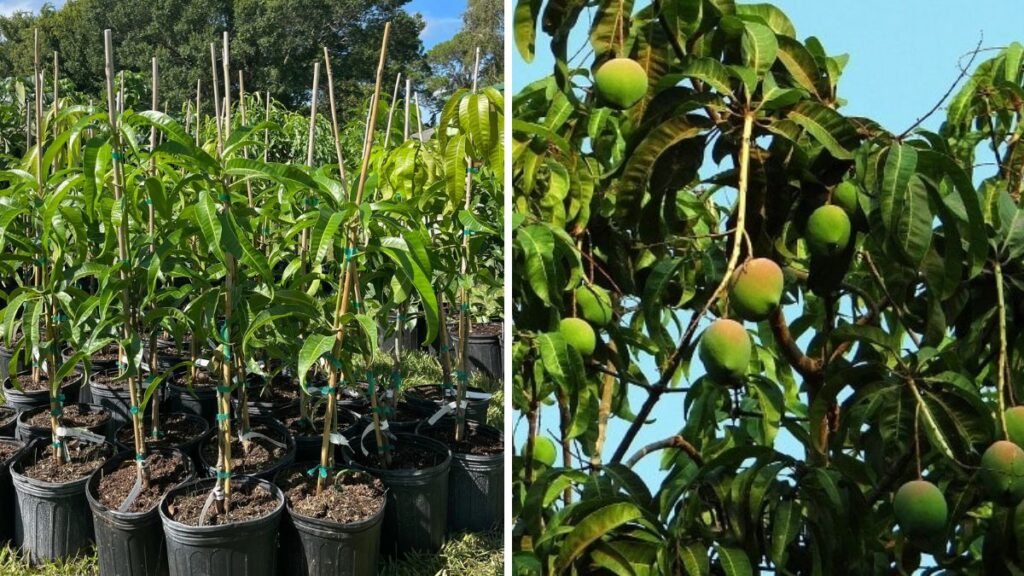
Scion preparation determines graft quality. Select healthy shoots with dormant buds. Scion thickness should match the rootstock. Leaves are removed, leaving small petioles. Scion sticks are usually ten to fifteen centimeters long. They should be collected early morning. Avoid scions with active growth. Fresh scion wood improves success. Store scions in moist cloth if needed. Proper preparation ensures better union.
Step-by-Step Mango V Grafting Process
First, cut the rootstock at desired height. Make a clean V-shaped slit at the top. Prepare the scion by cutting its base into a wedge shape. Insert the scion carefully into the slit. Ensure cambium layers touch on at least one side. Tie the graft firmly using plastic strip. Cover the graft to retain moisture. Place the plant in shade. Monitor regularly for growth signs.
Aftercare Management of Grafted Plants
Post-grafting care is critical. Keep plants in partial shade for two to three weeks. Water regularly but avoid excess moisture. Protect graft from direct sunlight and wind. Remove any shoots emerging from rootstock. Spray mild fungicide after ten days. Gradually expose plants to sunlight. Support weak grafts with sticks. Proper aftercare increases survival rate.
Healing and Graft Union Formation
Successful graft union forms within three to four weeks. Callus tissue develops at the joint. New shoots emerge from the scion buds. Remove tying material once union is strong. Avoid disturbing the graft. Healing speed depends on temperature and humidity. Strong union ensures long-term stability. Weak unions break easily. Proper alignment ensures good healing.
Training and Pruning of Grafted Mango Plants
Training helps shape the mango plant. Remove extra shoots to form a single stem. Pruning encourages strong branching. Maintain proper height for orchard management. Remove weak or crossing branches. Balanced canopy improves sunlight penetration. Regular pruning improves fruit quality. Grafted plants respond well to pruning. Training ensures long life and productivity.
Nutrient Management for V Grafted Mango
Balanced nutrition supports healthy growth. Organic manure improves soil fertility. Nitrogen supports vegetative growth. Phosphorus strengthens roots. Potassium enhances flowering and fruiting. Micronutrients prevent deficiencies. Avoid excess fertilizer in early stages. Split application is recommended. Proper nutrition ensures uniform growth.
Common Problems and Their Solutions
Graft failure may occur due to poor alignment. Dry scions reduce success. Excess moisture causes fungal infection. Weak rootstocks fail to support scion. Pest attacks damage tender shoots. Regular inspection prevents losses. Use recommended practices. Timely correction improves success rate. Experience improves results.
Advantages of Mango V Grafting
V grafting offers many advantages. High success rate is the biggest benefit. Plants bear fruits earlier. Uniformity improves orchard management. True-to-type plants are produced. Suitable for mass multiplication. Cost-effective technique. Easy to learn and practice. Widely accepted by nurseries.
Economic Benefits for Farmers
Grafted mango plants fetch higher prices. Early fruiting increases income. Uniform harvest simplifies marketing. Reduced risk compared to seedling trees. Nursery owners earn good profit. Long-term productivity improves. Export quality fruit is achievable. Economic sustainability increases.
Comparison: Seedling vs V Grafted Mango
| Aspect | Seed Grown Mango | V Grafted Mango |
|---|---|---|
| Fruiting Time | Late | Early |
| Uniformity | Low | High |
| Fruit Quality | Variable | Consistent |
| Success Rate | Natural | Controlled |
| Market Value | Low | High |
Suitability for Small and Large Farms
V grafting suits all scales of farming. Home gardeners can grow quality mangoes. Commercial orchards benefit from uniform plants. Nursery businesses rely heavily on this method. It fits tropical and subtropical climates. Space utilization improves. Management becomes easier. Widely adaptable technique.
Long-Term Care of V Grafted Mango Trees
Regular pruning maintains structure. Balanced fertilization supports yield. Pest management protects productivity. Avoid water stress. Monitor graft union regularly. Replace weak plants early. Maintain soil health. Long-term care ensures decades of productivity.
Conclusion
Mango V grafting is a proven and efficient propagation method. It ensures early bearing, uniform growth, and superior fruit quality. With proper technique and care, success rates are high. Farmers and nursery owners can greatly benefit. This method supports modern mango cultivation. Adopting V grafting improves profitability. It remains one of the best techniques in mango propagation.